
- PNW-VEG Home
- About the Team
- Alert Archives
- Diagnostic Labs
- IPM Resources
- Photo Gallery of Vegetable Problems
- Publications
- Team Newsletter Archive
- Vegetable Resources
Lindsey du Toit
WSU Mount Vernon NWREC
16650 State Route 536
Mount Vernon, WA 98273
USA
Tel. 360•848•6140
Fax 360•848•6159
E-mail:
dutoit@wsu.edu

PNW-VEG Objectives
(See Poster, PowerPoint file)
- Assist with diagnoses of vegetable diseases, pests, and other problems
- Coordinate vegetable disease, pest, and production research and extension activities in the Pacific Northwest
- Provide growers and gardeners with resources to manage vegetable diseases, pests, and abiotic problems in environmentally-sound ways
- Publish new information about vegetable pathogens, pests and other problems; and their biology and management
- Serve the
region’s fresh vegetable, processing vegetable, and vegetable seed crop
industries
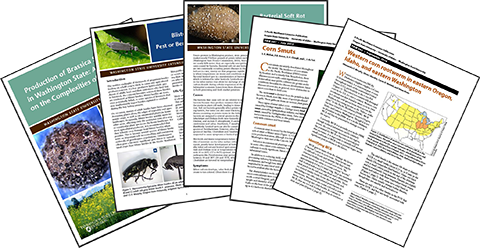
Several new vegetable extension bulletins published by members of the Pacific Northwest Vegetable Extension Group are shown above. These publications, and others, can be found on the Publications page of our website.
Vegetable Resource Highlights
2018 Integrated Pest Management Guidelines for Insects and Mites in Idaho, Oregon and Washington Potatoes (PDF), authored by Alan Schreiber, Agriculture Development Group, Inc.; Andrew Jensen, Northwest Potato Research Consortium; Silvia I. Rondon, Oregon State University; Erik J. Wenninger, University of Idaho; Stuart Reitz, Oregon State University.
Strip-Tillage for Onions and Sweet Corn - Lorin Grigg, Farmer-to-Farmer Case Study Series: Increasing resilience among farmers in the Pacific Northwest, by Georgine Yorgey, Center for Sustaining Agriculture and Natural Resources, Washington State University and Andrew McGuire, Irrigated Cropping Systems Agronomist, Washington State University Extension (PNW702). View on-line or download free PDF.
Spore sampling project to alert growers of disease threat. A University of Idaho-led research team plans to start giving their state’s potato growers advanced warnings this season about the arrival of fungal pathogens, using a broad network of airborne spore samplers.
We would like to make you aware of additional information stakeholders
can get from the
WSU Pesticide Information Center OnLine database
(PICOL).
The Washington State Pest Management Resource Service has reviewed
additional pesticide labels for inclusion of tobacco mosaic virus (TMV) as a
pest in PICOL, and has just added five disinfectant-type products to the
list:
· Consan Triple Action 20, EPA # 58044-3
· Ferti-lome Consan 20, EPA # 58044-3-7401
· Monterey Consan 20, EPA # 10324-94-54705
· Green-Shield Disinfectant & Algicide, EPA # 499-368
· Prescription Treatment Green-Shield Disinfectant & Algicide,
EPA # 499-368
These all are labeled for use in greenhouses and on cutting tools
(“utensils” in PICOL). To find currently registered products in WA or OR
which specifically list TMV on the label, you can now search directly for
the pest by name (tobacco mosaic virus) or by code (DTMV).
Washington State Deptartment of Agriculture Ag Briefs - An on-line blog with updates on issues of interest to the agriculture community and the public.
Organic Seed Alliance Seed Internship Program -
Matching the organic seed growers of tomorrow with the experienced growers
of today. The Seed Internship Program combines online and classroom
learning, farm-based independent study, and real-world experience through a
diverse network of family farms. Hosted by Organic Seed Alliance and the
Multinational Exchange for Sustainable Agriculture (MESA), the Seed
Internship Program matches individuals who want to learn about seed
production with experienced growers.
Further info:
Details and sign-up.
We had a new extension bulletin
published in May, 2016.
Follow the link to read it.
Internal Dry Scale and Associated Bulb Rots of Onion (PDF)
Pacific Northwest Extension publications are produced cooperatively by the three Pacific Northwest land-grant universities: Washington State University, Oregon State University, and the University of Idaho. Similar crops, climate, and topography create a natural geographic unit that crosses state lines. Since 1949, the PNW program has published more than 650 titles, preventing duplication of effort, broadening the availability of faculty specialists, and substantially reducing costs for the participating states.
Small-Scale Cost-Effective Hot Water Seed Treatment
By Frank Morton (Wild Garden Seed), Tom Stearns (High Mowing Seeds), Nick Andrews (OSU Small Farms Extension)
Hot water seed treatment is an important way of reducing the risk of seed-borne diseases, especially for organic Brassica growers (seed, fresh market or processed market) now that Pacific Northwest growers are dealing with black leg and potential light leaf spot epidemics. Hot water treatment can improve our defense against diseases like blackleg, light leaf spot, Verticillium, Fusarium, Xanthomonas, Alternaria, Botrytis and many seed-bourne viruses.
The authors have put together some slides with some practical ideas for
low-cost and efficient hot water treatment.
Download the Hot Water Treatment Slideshow (PDF).
WSU Potato Pest Alert Survey
During each growing season, this website links to current issues of the WSU Potato Pest Alert, published periodically by Washington State University Extension with funds provided by a grant from the Washington State Potato Commission (see below).
The publishers of the Potato Pest Alert have created a survey to find out
what you think of WSU Potato Pest Alerts. It's important to justify their
efforts in conducting the insect monitoring program and writing the alerts.
Click
HERE to take the survey.
There are some additional questions for those of you who manage potato crops
in the Columbia Basin, but it is especially important for the publishers to
understand how you use this service and which pests are on your radar. The
questions should still take less than 5 minutes to answer.
-
Crucifer Seed Emergency Rule
Effective July 16, 2015
For those of you who work with bean and/or crucifer crops of any kind (oilseed, cover, processing, fresh market, seed, forage, etc.), here is important and time-sensitive information from Victor Shaul of the WSDA Seed Program on proposed amendments to two quarantine rules in WA.
1) The WSDA Crucifer Quarantine: "The public hearing for the Crucifer seed quarantine was held on July 7th. There were some substantive changes that occurred during the hearing. The main change; in red below, was at the request of those in attendance at the hearing. In essence, this change says that seed that was produced within the regulated areas (both the Eastern and Western Washington areas) to be planted in the Eastern Washington regulated area does not have to be treated. In converse, seed originating elsewhere will need to be treated.
"To recap the changes the rule proposal will:
· Not change any requirements already in place for Crucifer seed to be planted in Western Washington.
· Will include Eastern Washington under the Crucifer Quarantine rules.
· Will require any Crucifer seed that will be planted in Eastern Washington to be laboratory tested and found free of Blackleg.
· Will require any Crucifer seed from an origin outside the regulated areas* that will be planted in Eastern Washington to be treated – various options.
· Will require any Crucifer seed that will be planted in Eastern Washington to have each container tagged with a Crucifer Quarantine tag issued by the Department.
*For reference an area outside the regulated areas would be any area outside the Western Washington counties of Clallam, Island, Lewis, Skagit and Snohomish and all counties in Eastern Washington.
"The second major occurrence was the request to implement the rule changes immediately. The reasoning behind this request was the time it would take with the normal rule process for the rule changes to become effective. In essence it would miss the fall planting season. It was felt that this is such an important threat to Crucifer production that an emergency rule should be enacted as soon as possible. To that end the Director signed the emergency rule effective on Thursday July 16th. As of that date all Crucifer seed to be planted in Eastern Washington must be quarantine compliant.
"Lastly, due to the requested changes in the language there will be a second public hearing. Comments can be sent by e-mail if that is more convenient. I will send that information as well.
"I would ask everyone to assist in spreading the word about this through whatever means you can. We are currently working on a fact sheet and mailer and hope to have that completed soon with plans to send to as wide of an audience as possible.
"Additionally, you will see attached a Crucifer Quarantine tag request form. Please note this is specific for seed that is to be planted in Eastern Washington. Please pass along to whomever in your company that will be handling this.
"I have also been asked what kind of seed treatments can be used for Blackleg. Here is a resource you can use: https://cru66.cahe.wsu.edu/LabelTolerance.html and of course consult your seed treatment/chemical provider for further assistance."
Please provide feedback or recommendations to:
Victor Shaul, WSDA Seed Program Manager
vshaul@agr.wa.govFurther Info:
- Proposed Crucifer Quarantine Rule Amendments (PDF) (May, 2015)
- Proposed Rule Amendments, Amendatory Section (PDF) (July, 2015)
- Crucifer Quarantine tag request form (.docx)2) The WSDA Bean Seed Quarantine ruling:
Victor Shaul: "First off thank all of you that provided input and took your time coming to meetings on this important topic.
"The public hearing for the changes to the Bean Seed Quarantine was held on July 7th. Those in attendance were in favor of the proposed changes to the quarantine. The effective date of these changes is August 21, 2015.
"To re-cap the changes to the quarantine are:
· Bean seed fields under sprinkler irrigation will require three inspections with the option of laboratory testing for halo blight in lieu of the first inspection.
· The elimination of the Notice of Intent quarantine reporting form. This will be replaced with the requirement to attach proof of quarantine compliance with every phytosanitary or certified field inspection application.
"As previously discussed these changes come too late for this season, but I am really pleased at the number of field inspection applications that were submitted for this season that proactively implemented these methodologies.
"These changes will necessitate new application and inspection forms, so that will be an internal winter project and you will be provided with new applications to use at that time."
Please provide feedback or recommendations to:
Victor Shaul, WSDA Seed Program Manager
vshaul@agr.wa.govFurther Info:
Proposed Bean Seed Quarantine Rule Amendments (PDF)
-
Vegetable Crop Management 101 Workshop
(In English and Spanish). Proceedings from the Pacific Northwest Vegetable Association pre-conference 'Vegetable Crop Management 101’ Workshop, Nov. 17, 2015, Kennewick, WA. - Washington State weed or plant identification requests can be made through the Washington State University Crop and Soil Sciences Weed Identification website. Weed specimens may be submitted as digital images or as physical specimens, at no charge, by following instructions on this site.
- At the Sept. 11. 2014 Crucifer Disease Meeting in Oregon three presentations were given to update stakeholders on the current situation in the Willamette Valley for black leg, light leaf spot, and white leaf spot in crucifer crops. Powerpoint presentations by Cindy Ocamb (OSU), Nancy Osterbauer (ODA), and David Priebe (ODA), are available here in PDF versions.
- Black Leg, Light Leaf Spot, and White Leaf Spot (PDF), Cynthia Ocamb, PhD., Plant Pathologist, OSU Extension, Associate Professor--Botany & Plant Pathology.
- Addressing Blackleg in the Willamette Valley (PDF) - Temporary rule and proposed changes to the permanent rule of the Oregon Department of Agriculture, Nancy K Osterbauer, State of Oregon, Oregon Department of Agriculture, Plant Protection and Animal Health.
- Fungicides for Control of Black Leg (PDF), David Priebe, Pesticides Program, Oregon Department of Agriculture.
-
Alert: Black leg in Brassicaceae Crops and Wild Crucifers (PDF).
A widespread epidemic of black leg occurred on a diversity of crucifer
oilseed, cover, forage, and vegetable seed crops in the Willamette Valley of
Oregon in spring 2014. Black leg can be a significant problem for growers of
fall- or spring-sown plantings of various crucifer crops, particularly under
the favorable environmental conditions for this disease in the Pacific
Northwest. Phoma lingam (sexual stage: Leptosphaeria maculans)
is the fungus that causes black leg. In fact, back leg is a quarantine
disease for five counties in northwestern Washington. Brassicaceae plants
that can be infected include species of Brassica (e.g., broccoli,
Brussels sprouts, cabbage, canola, cauliflower, various Chinese brassica
vegetables, collard, kale, mizuna, mustard, oilseed rape, oilseed turnip
rape, rutabaga, turnip, etc.), Sinapis (white and yellow mustard),
and Raphanus (daikon and radish). Several wild species exist that
may be infected by P. lingam.
Brown Marmorated Stink Bug (BMSB)
The Oregon State University Department of Horticulture has information on the Brown Marmorated Stink Bug which is widespread in the Willamette Valley, and its possible damage to crops including vegetables.
In 1988, a statewide survey revealed 23 species of stink bug in Washington. In 2014, this number was increased to 47 species including the invasive and dreaded Brown Marmorated Stink Bug that was found in a handful of counties. We have reasons to believe more stink bugs exist in Washington State. If you capture any bug that resembles a stink bug, WSU Extension desperately needs the specimen mailed to us along with information that provides us with where (the town or county or GPS location captured), when (date) and on what host plant they were found on.
For the details, go here: WANTED DEAD OR ALIVE: Stink Bugs Still At Large in Washington State.Update 11/12/2014: Invading stink bug eats Cinderella’s pumpkins. See More...
Update 10/22/2015: New ‘Alien’ wasp discovered in Washington state - Parasitizes and Kills BMSB. See More...
Disease Alert – Light Leaf Spot in Crucifer Seed Fields in the Willamette Valley. (PDF) Beginning late March 2014, I found several leaf spot diseases in fall-sown crucifer crops and weedy species in the Willamette Valley. A survey in OSU research fields of fall-sown canola during late October in 2013 showed no leaf spots or seed/seedling diseases. However, light leaf spot caused by the fungus Cylindrosporium concentricum (sexual stage: Pyrenopeziza brassicae) was observed causing disease this spring in canola research fields as well as in commercial seed fields of forage Brassica species and “field” turnip. Light leaf spot was subsequently detected in other Brassica members including wild mustard, volunteer black mustard, vegetable Brassica seed fields, and Brassica species used as cover crops during 2014. While the specific host range for C. concentricum within the tribe Brassiceae is unknown at this time, it is likely that all brassicas crops grown in the Pacific Northwest are susceptible (1) with a range of susceptibility within each crop species. This disease hasn't been previously reported in North America, although an infected mustard field was found in western Oregon during 1998. Oilseed rape can be very susceptible with losses resulting from stand die-out, reduced pod numbers, and premature pod ripening; with less severe infections there is an overall growth reduction. Brassica species grown as vegetables in other areas of the globe, where this disease has been reported, suffer blemish defects that result in a decrease in quality but not quantity of yield.
Disease Alert – White Leaf Spot in Crucifer Seed Fields in the Willamette Valley (PDF). White Leaf Spot and Gray Stem in Crucifer Seed Crops in Western Oregon, 2014 Beginning late March 2014, I found several leaf spot diseases in fall-sown crucifer crops and weedy species in the Willamette Valley. A survey in OSU research fields of fall-sown canola during late October 2013 showed no leaf spots or seed/seedling diseases. However, white leaf spot and gray stem caused by the fungus Pseudocercosporella capsellae (sexual stage: Mycosphaerella capsellae) were observed during 2014 in canola research fields as well as in commercial seed fields of forage Brassicas and “field” turnip. White leaf spot was also detected in volunteer black mustard and forage fields. Susceptible hosts reportedly include species of Brassica (broccoli, cabbage, canola, cauliflower, Chinese cabbage, mustard, turnip, etc.) as well as radish and horseradish. Weedy types such as wild radish, wild mustard, and shepherd's purse are susceptible to white leaf spot and gray stem.
Potato Pest Alert:
This is the 20th Potato Pest Alert issued for the 2020 growing season. The Regional Washington State University Extension Potato, Vegetable and Seed Crops Specialist posts numerous and time-sensitive 'Potato Pest Alerts' during the Pacific Northwest potato growing season. View the Latest Update (09/11/2020).
TABLE OF CONTENTS
INSECT MONITORING REPORTS:
POTATO PSYLLIDS
POTATO TUBERWORM
RESULTS TABLE
IPM GUIDES & SUPPORT:
IPM GUIDES & INFO
DIAGNOSTIC LABS
WEATHER:
AGWEATHERNET OUTLOOK
OTHER INFORMATION:
WILDFIRES, AIR QUALITY & SMOKE FORECAST
Recent WSU Potato Pest Alert emails are archived on the WSU Extension Irrigated Agriculture Email Archive page.
If you would like to subscribe, click HERE and choose "Potato Pest Alert" and any other topics that are important to you.
-
Hello Potato Pest Alert Subscriber
This is a special issue to let you know that a manual is available to help potato growers who are preparing for the Potato Sustainability Initiative (PSI) audit this year.
Manual and Resources Now Available to Help Navigate the Potato Sustainability Initiative (PSI) Survey and Audit
Announcements recently went out on whether you will be audited in person for your 2017 responses to the Potato Sustainability Initiative (PSI) survey. Most process growers are requested to participate in the PSI sustainability survey and approximately 20% of the growers who completed the survey will be audited each year. The audit involves an interview between the grower and auditor with specific questions and an inspection of documents. A manual has been developed to help growers methodically and successfully gather required documents for the audit, with examples of standard operating procedures, and resources to help answer interview questions. The manual is posted at www.uidaho.edu/potatoes. Changes to this manual will be done periodically to adjust for changes to the PSI survey. The manual was developed by IACI, University of Idaho, and Washington State University with funding from the NW Potato Research Consortium.
This image shows symptoms of late blight on a newly sprouted plant from an infected seed piece. Photo Source: D.A. Inglis and J. Gigot.
Please contact Dennis Johnson at 509-335-3753 to report, confirm, or make a late blight diagnosis. The hotline number is 1-800-984-7400.
New ‘Tomato MD’ App Helps Users Diagnose and Treat Sick Tomato Plants: Tomatoes are one of the most common crops in the U.S. But while popular, they are not always easy to treat when affected by plant diseases or bugs. With such a wide range of pests that affect tomato plants, growers can have a difficult time identifying and treating them.
Enter Tomato MD, part of the new “Plant Health” family of apps for the iPhone or iPad. Tomato MD is an interactive reference that helps gardeners, professional growers, and consultants identify and manage more than 35 key diseases, insects, and physiological disorders of tomatoes.
Tomato MD is unique in that tomato experts have peer-reviewed all content to ensure the images and information are accurate. And while the information was reviewed by scientists, it is very accessible and published in an easy-to-use, non-scientific format.
Fact Sheet: Food Safety and Modernization Act (FSMA) Proposed Rule for Produce Safety: Standards for the Growing, Harvesting, Packing, and Holding of Produce for Human Consumption (PDF). The FDA’s website provides some highlights about the rule, who the rule covers, compliance information, and where to go for more information. This proposed rule has major potential ramifications for freshly consumed foods, including many vegetables.
Bacterial Ring Rot on Potatoes (PDF). Washington State University Extension Bulletin. This publication provides information on the bacterial ring rot pathogen, its disease cycle, and ring rot management on potatoes.
Production of Brassica Seed Crops in Washington State: A Case Study on the Complexities of Coexistence (PDF). Washington State University Extension Bulletin. The document was developed in response to the numerous controversial issues surrounding production of brassica vegetable seed crops, brassica oilseed crops, brassica oilseed seed crops, brassica cover crops, etc. in proximity given the risks of cross-pollination, introduction of seedborne, quarantine pathogens into some areas that are highly conducive to these pathogens, the prevalence of GMO traits in some brassica crops like canola vs. the zero-tolerance for GMO traits by many of the markets that buy brassica vegetable seed from the PNW, etc.
Brown Marmorated Stink Bug (BMSB). Oregon State University Department of Horticulture. Information on BMSB which is widespread in the Willamette Valley, and its possible damage to crops including vegetables.

Appropriate precautions to prevent
introduction and spread of Tomato brown rugose fruit virus (ToBRFV) in
the USA!
Tomato brown rugose fruit virus (ToBRFV) is a virus that infects tomato
and pepper that is readily spread by contact with equipment, people, and plants.
The virus is also seedborne. ToBRFV was first found in Israel in 2014, and has
since spread to at least eight other countries. In 2019, ToBRFV was found on
some fruit imported into Florida. The fruit was destroyed to prevent spread of
the virus in the USA. Read about this virus and appropriate measures you can
take to avoid accidental introduction of the virus into the USA. To learn more
about ToBRFV and efforts to safeguard against its introduction into the United
States, please read the
USDA FactSheet
on ToBRFV and visit the
USDA
APHIS ToBRFV web page.
Upcoming Events
- From the Ground Up: Cover Crop Solutions for Western Farmers, Virtual Series, Dec. 10, Dec. 17, Jan. 7 and Jan. 14. 11:00 pm PT – 12:30 pm PT - all dates.
- Webinar: Biological Control Options in Vegetable Production. Feb. 3, 11AM Pacific
- Webinar: Insect-vectored Viruses and their Management in Vegetable Production. Feb. 10, 11AM Pacific
- Webinar: Biological Control of Whiteflies in Squash. Feb. 24, 11AM Pacific
Our pages provide links to external sites for the convenience of users. WSU Extension does not manage these external sites, nor does Extension review, control, or take responsibility for the content of these sites. These external sites do not implicitly or explicitly represent official positions and policies of WSU Extension. /p>