
Sintayehu Daba
Postdoctoral Research Associate
Sintayehu Daba joined the Vegetable Seed Pathology program in September 2024 as a Postdoctoral Researcher Associate for the USDA NIFA Specialty Crops Research Initiative Grant No. 2023-51181-41321 on spinach Fusarium wilt. This collaborative project, involving multiple universities and a USDA unit in Salinas, CA, aims to develop molecular breeding methods and phenotyping tools to accelerate spinach cultivar development, focusing on five diseases, including Fusarium wilt, which Sintayehu will research. He will build on the research on spinach Fusarium wilt accomplished by a former postdoctorate in the vegetable seed pathology program, Sanjaya Gyawali. Sintayehu is originally from Ethiopia, where he earned both his BSc in Plant Sciences and MSc in Plant Breeding from Alemaya University. After his BSc, he spent 10 years as a barley breeder at the Ethiopian Institute of Agricultural Research, including three years leading regional barley breeding programs. In 2010, he moved to the U.S. to pursue a PhD in Plant Breeding and Genetics at North Dakota State University (NDSU), focusing on genome-wide association mapping of agronomic, disease resistance, and quality traits in barley accessions from Ethiopia, ICARDA (International Center for Agricultural Research in the Dry Areas), and the U.S. After earning his PhD in 2015, he worked at Purdue University for nearly four years in the soft red winter wheat breeding program, overseeing overall operations of the program, and later briefly returned to NDSU for genomic prediction research in the hard red spring wheat breeding program. In October 2020, he joined the USDA-ARS Western Wheat Quality Lab, where he completed several projects on pea protein and starch quality. His research interests include genetic mapping, proteomics, and developing predictive models such as genomic prediction and NIRS calibration. Sintayehu lived in Burlington, WA with his wife Yeshiwork Tae and their three daughters: Kena S. Debebe (a college student), Kiya S. Debebe (a high school student), and Ayantu S. Debebe (a middle school student). He likes things such as visiting scenic nature locations and playing soccer.

Sanjaya Gyawali
2018-2021 Postdoctoral project: Marker-assisted selection for resistance to Fusarium wilt of spinach
Sanjaya Gyawali’s Postdoctoral Research Associate position is funded by the 4-year USDA NIFA Specialty Crop Research Initiative Grant No. 2017-51181-26830, a collaboration with the University of Arkansas on marker assisted selection for resistance in spinach germplasm to downy mildew, white rust, and Fusarium wilt. Sanjaya is leading the screening of spinach germplasm for resistance to Fusarium wilt. He obtained a BSc degree in plant pathology and an MSc degree in plant breeding from Tribhuvan University in Nepal, where he also served as a Research and Teaching Assistant in 2000-2001. Sanjaya then worked as a Senior Rice Breeder for the Local Initiative for Biodiversity Research and Development (LI-BIRD) in Nepal from 2001-2005, and completed a PhD degree in plant pathology at North Dakota State University from 2006-2010. From 2010 to 2012, Sanjaya was a Visiting Research Fellow (Postdoctorate) at Agriculture and Agri-Food Canada in Saskatoon, Canada, where he was involved in breeding rapeseed (Canola), particularly for resistance to white mold caused by Sclerotinia sclerotiorum. From 2013-2016, he served as the Barley Breeder for the International Center for Agricultural Research in Dry Areas (ICARDA), working on barley improvement program with almost 100 scientists from 30 countries. In 2017, Sanjaya became a Research Associate and Instructor at the University of Manitoba in Winnipeg, Canada, breeding for resistance to Fusarium head blight of wheat and barley, and teaching a plant disease management course. We were very pleased to have Sanjaya lead the spinach Fusarium wilt breeding aspect of this project with his expertise in disease resistance breeding, genetics, plant-pathogen interactions, molecular genetics, genomics, QTL mapping, genome-wide association studies (GWAS), and marker assisted selection. In July 2021, Sanjaya took a position as a plant pathologist with Sakata Seed America, based in Mount Vernon, WA. Sanjaya lives in the Skagit Valley with his wife, Dr. Sharmila Sunwar, and daughter, Samridhee (Sammy).
Publications from his postdoctorate position:
- Batson, A.M., Gyawali, S., and du Toit, L.J. 2022. Shedding light on races of the spinach Fusarium wilt pathogen, Fusarium oxysporum f. sp. spinaciae. Phytopathology 112:2138-2150.
- Gyawali, S., Bhattarai, G., Shi, A., Kik, C., and du Toit, L.J. 2021. Genetic diversity, structure, and selective sweeps in Spinacia turkestanica associated with the domestication of cultivated spinach. Frontiers in Genetics 12:740437.
- Gyawali, S., Derie, M.L., Gatch, E.W., Sharma-Poudyal, D., and du Toit, L.J. 2021. Lessons from 10 years of stakeholder adoption of a soil bioassay for spinach Fusarium wilt. Plant Pathology 70:778-792.

Louisa Winkler (neé Brouwer)
2018 Research Associate
Louisa Winkler graduated with her PhD in plant breeding and genetics from Washington State University in 2017. Before moving to the USA in 2013, Louisa worked on an agroforestry farm in the UK. Throughout her career in agriculture, she has specialized in the needs of organic and low external input production systems. Louisa now lives on San Juan Island, where she collaborates remotely with the Vegetable Seed Pathology program in addition to working on organic grain and vegetable seed production. Her work with Lindsey’s program from January to March 2018 is funded by a BIOAg Planning Grant from the WSU Center for Sustaining Agricultural & Natural Resources, to help prepare a 7-state, USDA NIFA Specialty Crop Research Initiative grant proposal to support research on bacterial diseases in onion production across the USA. From March to December of 2018, Louisa worked half-time in Lindsey’s program to help finish up a project funded by the WSDA Specialty Crop Block Grant evaluating arbuscular mycorrhizal fungi in onion production in the Columbia Basin of Washington and Oregon.
Publications from postdoctorate:
- du Toit, L.J., Brouwer, L.R., Derie, M.L., Henrichs, B.A., Holmes, B.J., and Waters, T.D. 2020. The effect of formulation and application method of commercial arbuscular mycorrhizal fungi inoculants on onion seedlings in a growth chamber study, 2016. Plant Disease Management Reports 14: V059.
- du Toit, L.J., Derie, M.L., Holmes, B.J., Miller, C.E., Brouwer, L.R., Waters, T.D., and Darner, J. 2020. Effects of three arbuscular mycorrhizal fungi inoculants on pink root and yield in a commercial onion bulb crop near Othello, WA, 2017. Plant Disease Management Reports 14:V061.
- du Toit, L.J., Derie, M.L., Holmes, B.J., Miller, C.E., Morgan, P., Brouwer, L.R., Waters, T.D., and Darner, J. 2020. Effects of Mykos Gold Granular, an arbuscular mycorrhizal fungi inoculant, on pink root, white rot, and crop growth in spring- and fall-planted sweet onion crops near Walla Walla, WA, 2017-2018. Plant Disease Management Reports 14:V060.
- du Toit, L.J., Derie, M.L., Holmes, B.J., Winkler, L.R., Waters, T.D., and Darner, J. 2020. Effects of an arbuscular mycorrhizal fungal inoculant and a mycorrhizal stimulant on pink root and productivity of dehydration onion crops near Paterson, WA, 2016. Plant Disease Management Reports 14:V062.
- Winkler, L., du Toit, L., and Waters, T. 2019. Mycorrhizal inoculants: Yea or nay? The effects of mycorrhizal inoculants on onion crops in the Columbia Basin. Onion World, Feb. 2019:1014.
https://issuu.com/columbiamediagroup/docs/feb_2019_onion_world_web?e=34405975/67413329 - Effects of the arbuscular mycorrhizal fungi inoculant Mykos Gold Granular on pink root and yield in commercial onion bulb crops near Irrigon, OR, 2017 (pdf). du Toit, L.J., Derie, M.L., Holmes, B.J., Miller, C.E., Brouwer, L.R., Waters, T.D., and Darner, J. 2019. Plant Disease Management Reports 13:V008. (PDF)
- The influence of soil phosphorus levels on onion root colonization by mycorrhizal fungi from commercial inoculants, 2017 (pdf). du Toit, L.J., Derie, M.L., Holmes, B.J., Morgan, P., Brouwer, L.R., and Waters, T.D. 2019. Plant Disease Management Reports 13:V009.
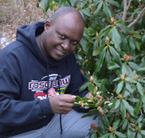
Leonard Kiirika
Project: Evaluation of arbuscular mycorrhizal fungi in onion and carrot production in the Columbia Basin of the Pacific Northwest USA.
Leonard Kiirika was born in Meru District on the eastern slopes of Mt. Kenya. His passion for agriculture started while he was a young boy. He enjoyed raising plants in the backyard of his family house, and accompanying his mother in the field. After high school education at Nkubu Boys’, Leo joined Jomo Kenyatta University of Agriculture and Technology (JKUAT) in Nairobi, Kenya to pursue a degree in Horticulture (completed in 2004). Leonard then worked in various managerial positions within companies in Kenya, including Tambuzi (K) Ltd. and DuduTech (K) Ltd., as well as non-governmental organizations such as SOS Sahel (United Kingdom) and Resource Projects Kenya. His interest in pursuing further education was influenced by Profs. Losenge Turoop (his undergraduate supervisor) and John Wesonga from the Department of Horticulture at JKUAT, as a result of specializing in plant pathology. After observing a wilt disease in the field, Leonard submitted a research proposal to Deutscher Akademischer Austauch Dienst (DAAD) –German Academic Exchange Service, and was offered a 2-year scholarship to pursue a masters degree in International Horticulture at Leibniz University in Hannover, Germany, majoring in Plant Pathology and Entomology under the direction of Prof. Kerstin Wydra. Leo’s masters thesis project was on the effects of silicon and chitosan on resistance induction against bacterial wilt in tomato caused by Ralstonia solanacearum (graduated in 2010). Leo also completed field training at Queckbrunnenhof Agricultural Experimental Station in Rheinpfalz in the Bayern region of south Germany, supervised by Dr. Nobert Laun. He later submitted a second proposal to DAAD to fund his PhD degree at the same university with Profs. Hans Peter Braun and Udo Schmitz, under the project lead of Frank Colditz. His PhD dissertation was on molecular aspects of early microbial infection in Medicago truncatula Gaertn (degree completed in 2013). Leo aimed to provide an understanding of the molecular mechanisms underlying symbiotic and pathogenic interactions in legumes, particularly by characterizing the role of small G proteins during plant-microbe interactions. Leo then completed a postdoctorate position in the same group (2014) before joining Prof. Caitilyn Allen’s program at the University of Wisconsin-Madison in the USA as a Postdoctoral Research Associate (2014 to January 2016). His research in that program was funded by the US National Science Foundation, and focused on how the soilborne pathogen Ralstonia solanacearum, which causes a lethal wilt of many crops worldwide, utilizes inorganic nitrogen metabolism to cause disease. Leonard started as a Postdoctoral Research Scientist in Prof. Lindsey du Toit’s program at the WSU Mount Vernon NWREC in 2016 to gain experience in vegetable seed pathology, particularly field-oriented research, with a focus on the potential impact of arbuscular mycorrhizal fungi on onion and carrot production in the semi-arid, irrigated Columbia Basin of the inland Pacific Northwest.

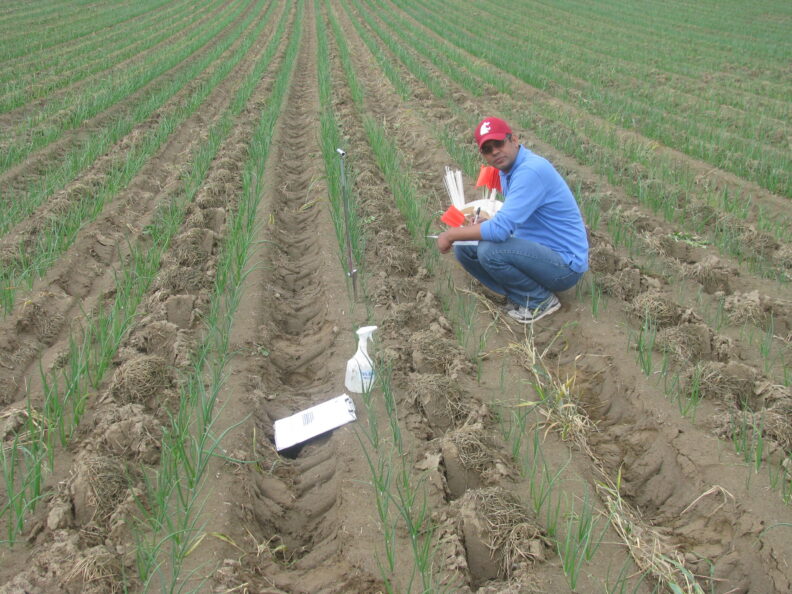
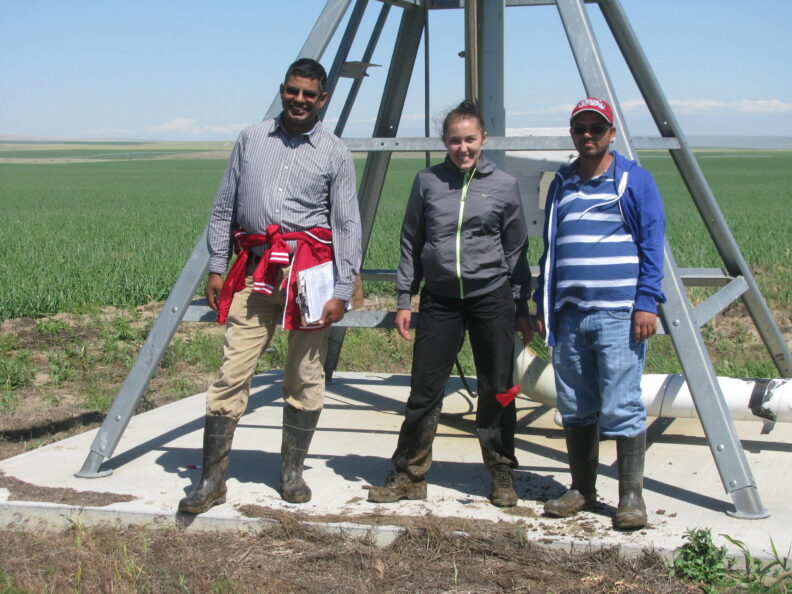
Dipak Sharma-Poudyal
Postdoctorate from May 2012 to June 2014. Project: Management of stunting in onion bulb crops in the Pacific Northwest caused by Rhizoctonia.
Dipak Sharma-Poudyal grew up in Chitwan, Nepal. He received his BS degree in Agricultural Science in 1998 and an MS degree in Plant Pathology in 2001 from Tribhuvan University, Nepal. His MS research was on rice root knot nematode, and his thesis was entitled “The Rice Root Knot Nematode: Its Impact on Rice-Wheat System of Nepal”. Dipak then worked as a lecturer in the Department of Plant Pathology, Rampur Campus, Tribhuvan University, Nepal from 2001 to 2007. During this period he carried out research on wheat and rice diseases. Dipak joined the lab of Dr. Xianming Chen at Washington State University in Pullman, WA in August 2007 as a PhD student. He completed his PhD research in spring 2012 on the “Prediction of disease damage, determination of pathogen survival regions, and characterization of international collections of wheat stripe rust.” From May 2012 to June 2014, Dipak was a postdoctoral research associate at Washington State University with Drs. Lindsey du Toit and Tim Paulitz. His postdoctorate project was on the epidemiology and management of Rhizoctonia in onion and pea cropping systems in the Columbia Basin of Washington and Oregon States. In July 2014, Dipak started a position with the Oregon Department of Agriculture based in Salem, OR.
Publications from postdoctorate:
- Sharma-Poudyal, D., Paulitz, T., Porter, L., and du Toit, L. 2016. Screening of pea genotypes for resistance to root rot caused by Rhizctonia solani (pdf) AG 8, 2012. Plant Disease Management Reports 10:FC184.
- Sharma-Poudyal, D., Paulitz, T.C., and du Toit, L.J. 2015. Stunted patches in onion bulb crops in Oregon and Washington: Etiology and yield loss (pdf). Plant Disease 99:648-658.
- Sharma-Poudyal, D., Paulitz, T.C., Porter, L.D., and du Toit, L.J. 2015. Characterization and pathogenicity of Rhizoctonia and Rhizoctonia-like species from pea crops in the Columbia Basin of Oregon and Washington (pdf). Plant Disease 99:604-613.
- Sharma-Poudyal, D., Paulitz, T.C., and du Toit, L.J. 2015. Evaluation of onion genotypes for resistance to stunting caused by Rhizoctonia solani AG 8 (pdf). HortScience 50:551-554.
- Knerr, J., Sharma-Poudyal, D., Paulitz, T., and du Toit, L.J. 2014. Evaluation of arbuscular mycorrhizal fungi (AMF) in conventional and organic onion production in the Columbia Basin, and the potential use of AMF to reduce the impact of soilborne pathogens of onion (pdf). WSU Center for Sustaining Agriculture & Natural Resources (CSANR) BIOAg Symposium “Saving Nature and Improving Agriculture: Where does Nature’s Wisdom Lie?”, 28 Oct. 2014, Pullman, WA.
- Sharma-Poudyal, D., Paulitz, T.C., Linderman, R.G., and du Toit, L.J. 2014. Effect of arbuscular mycorrhizal fungi on onion growth and onion stunting caused by Rhizoctonia solani, 2013 (pdf). Plant Disease Management Reports 8:V305.
- Sharma-Poudyal, D., Eggers, J., Paulitz, T.C., Hamm, P., and du Toit, L.J. 2014. Effect of deep vs. shallow tillage on onion stunting and onion bulb yield, 2012 (pdf). Plant Disease Management Reports 8:V306.
- Poudyal, D.S., Paulitz, T., Porter, L., Eggers, J., Hamm, P., and du Toit, L.J. 2013. Effect of timing of glyphosate application to a winter cover crop on stunting of spring-sown onions caused by Rhizoctonia spp. in the Columbia Basin of Washington, 2012 (pdf). Plant Disease Management Reports 7:V046.
- Poudyal, D.S., Paulitz, T., Porter, L., Eggers, J., Hamm, P., and du Toit, L.J. 2013. Efficacy of fungicides to manage onion stunting caused by Rhizoctonia spp. in the Columbia Basin of Oregon and Washington, 2011–2012 (pdf). Plant Disease Management Reports 7:V047.
- Poudyal, D.S., Paulitz, T., Porter, L., Eggers, J., Hamm, P., and du Toit, L.J. 2013. Yield responses of three onion cultivars to stunting caused by Rhizoctonia spp. in the Columbia Basin of Oregon and Washington, 2012 (pdf). Plant Disease Management Reports 7:V048.
- du Toit, L.J., Poudyal, D.S., Paulitz, T., Porter, L., Eggers, J., and Hamm, P. 2012. Onion stunting caused by Rhizoctonia: Management and economic importance in the Columbia Basin of Oregon and Washington (pdf). National Allium Research Conference, 12-14 Dec. 2012, Las Cruces, NM.
- du Toit, L.J., Poudyal, D., Paulitz, T., Porter, L., Hamm, P., and Eggers, J. Rhizoctonia seedling blight of onion crops in the Columbia Basin of Washington and Oregon (pdf). Handout at WSU Onion Field Day, 30 August 2012, L&L Farms, Connell, WA.
Martin Chilvers
2002-2003 Postdoctorate project: Development of a real-time PCR seed assay for Botrytis spp. associated with neck rot of onion.
Martin Chilvers grew up in Tasmania, Australia, where he received a B.S. degree in agriculture, with honors in plant pathology (1998), from the University of Tasmania. In 2003, Martin received a Ph.D. degree in plant pathology from the University of Tasmania under Drs. Frank Hay and Calum Wilson. His PhD dissertation was entitled “Epidemiology of Botrytis spp. associated with neck rot of onion in northern Tasmania, Australia.” In December 2003, Martin took a research associate position at Washington State University co-supervised by Drs. Lindsey du Toit and Tobin Peever in Pullman, WA. The project was focused on development of a real-time quantitative PCR assay for detection of neck rot Botrytis spp. associated with onion seed. Martin worked as a research associate for Dr. Tobin Peever from 2005-2007 at WSU, investigating various aspects of Ascochyta (Didymella) host specificity, epidemiology and genetics on chickpea. In 2007-08, Martin worked with Dr. Weidong Chen at the USDA ARS on the WSU Pullman campus, on Sclerotinia sclerotiorum in chickpea. In 2008, Marty moved to Michigan State University where he works as a Field Crops Pathologist/Assistant Professor.
Publications from postdoctorate:
- Chilvers, M.I., du Toit L.J., Akamatsu, H., and Peever, T.L. 2007. A real-time, quantitative PCR seed assay for Botrytis spp. that cause neck rot of onion. Plant Disease 91:599-608 (pdf).
- Chilvers, M.I., and du Toit L.J. 2006. Detection and identification of Botrytis species associated with neck rot, scape blight, and umbel blight of onion. Plant Health Progress: doi:10.1094/PHP-2006-1127-01-DG (pdf).
- Chilvers, M.I., du Toit, L.J., and Peever, T.L. 2005. RFLP differentiation of neck rot Botrytis spp. present in onion seed crops in Washington State, and development of a real-time PCR assay for detection of these fungi in onion seed. 23rd Fungal Genetics Conference, 15-20 March 2005, Pacific Grove, CA.
If you need the content provided on this site in an alternate format or for further information on the Vegetable Seed Pathology program, please contact: Lindsey du Toit at dutoit@wsu.edu or at 360-848-6140.