Zephyr is part of a global team that works collaboratively with universities and contract research organizations to develop regional efficacy data for specialty agriculture, including vineyard, tree, and vegetable crops. Her projects support regulatory and commercial efforts in California and the PNW. Past projects include Botrytis control on grapes, strawberry, hemp, and stone fruit, Sclerotinia control on lettuce, Fusarium control on tomato, and the effects of various beneficial microbes on the growth of grapes and almonds. She is grateful to have benefited from the investment of wonderful mentors and the support of her family throughout her education and career, and hopes to contribute in practical ways to the global advancement of sustainable agriculture. Zephyr joined WSU in summer 2022, and is studying while continuing employment at Lallemand Plant Care. Lindsey du Toit and Ian Burke are her co-advisors.
Stephanie has worked extensively with bacterial leaf spot (caused by Pseudomonas syringae pv. aptata = Psa) on beet and Swiss chard, and more recently started working with Phytophthora blight on pumpkin. Stephanie enrolled in the MS in Agriculture Plant Health Management degree at WSU in the spring of 2020. For her research project, she is investigating preventative chemical treatments to reduce Psa infection in beet and swiss chard seed crops. Stephanie is also researching Psa seedborne thresholds at which bacterial leaf spot symptoms develop under field conditions. Lindsey du Toit is serving as the chair of Stephanie’s committee, with David Weller and Lyndon Porter (USDA ARS plant pathologists) serving on her committee.
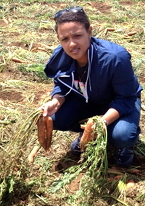
Billie Espejo
2017-2019 MS in Ag student
Billie Espejo lives in Durham, NC. She received a BS degree in Agriculture and Environmental Technology from North Carolina State University in 2013. During her undergraduate career, Billie was fortunate to have had several research opportunities; one of her most memorable experiences was participating in a Global Plant Health internship with Dr. Jean Ristaino’s program at North Carolina State University in the Department of Entomology and Plant Pathology, for which she spent three months learning about tropical plant diseases and studying nematodes at the University of Costa Rica in San Jose, CR. After completing the internship, Billie worked as an undergraduate research assistant in Dr. Eric Davis’ Nematology lab at North Carolina State University. Shortly after graduating, Billie joined AgBiome, an agricultural biotechnology company in the Research Triangle Park, NC. During her first years at AgBiome, Billie worked with the Microbiology Team, processing environmental samples and isolating thousands of bacterial strains to expand the microbe collection. She was introduced to the wealth of bacterial diversity present in environmental samples and agricultural soils across the U.S., and had the opportunity to learn about different bacterial isolation techniques and small-scale fermentation. In 2015, Billie transitioned into the Plant Pathology Team at AgBiome, where she’s involved in the development, validation, and optimization of high-throughput bioassays to test the activity of bacterial strains against fungal pathogens. Billie has worked with Fusarium spp. and Rhizoctonia solani on soybean, and is currently continuing the development of bioassays to test antifungal activity of bacterial strains against Pythium aphanidermatum on cucumber. Billie enrolled in the WSU MS in Agriculture degree program in fall 2017, with Dr. Lindsey du Toit as the chair of her committee and research project. Billie successfully completed her MS in Ag degree in December 2019 and has continued employment at AgBiome.
Dmitriy Lis
2014-2016 MS project: Screening sugar beets for resistance to Aphanomyces root rot.
Dmitriy Lis was born in Belarus, where he visited his grandparents’ farm every summer. He completed a BS degree in agriculture at the University of Minnesota, during which time he worked in the Agricultural Engineering Department on a project involving algae for biodiesel production. Dmitriy then worked in the Agronomy Department on a project screening local Minnesota plants for medicinal activity, for which he presented a poster at the Native American Conference and the University of Minnesota Undergraduate Research Symposium. After graduation, Dmitriy completed an internship with Syngenta, which led to him being employed full-time at Syngenta, where he worked on plant disease trials. Dmitriy then worked for Bayer CropScience doing herbicide trials. He now works for BetaSeed Inc., a daughter company of KWS, as a Research Technician in charge of sugar beet disease trials, particularly Aphanomyces root rot and Cercospora leaf spot trials. Dmitriy enrolled in an MS in Agriculture degree in fall 2014. His non-thesis project was on screening sugar beets for resistance to Aphanomyces root rot.
Publications from the MS in Ag degree:
- Lis, D. 2016. Greenhouse method of screening for resistance of sugar beet cultivars to root rot caused by Aphanomyces cochlioides (pdf). MS in Ag Final Report, Washington State University, Pullman, WA. 26 pp.
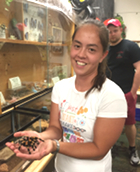
Christeena Sevy
2015 – 2017 MS project: Management of Verticillium wilt and nematodes in mint production in Idaho.
Christeena Sevy was raised in North Pole, Alaska. She started her science career as a freshman at the College of Idaho, where she was required to take a Biology of Birds class to meet her science requirements. During that course, Christeena was introduced to the ‘awesomeness’ of avian respiratory systems, and has been hooked on biology ever since. She switched from business to biology, and took on a music degree as well. Christeena graduated with honors from the College of Idaho in 2011 with a dual BS degree in biology and music, and the hope of becoming an ornithologist. After graduation, Christeena worked for the Idaho National Guard for two years on an environmental crew that completed surveys to determine if the army was blowing up too many things up in the Orchard Combat Training Center. She then worked as an analyst for Syngenta Seed Co. in Nampa, ID, where she developed a new appreciation for agriculture. This led Christeena to look for research-based employment, and her taking a position as a Field Technician at the University of Idaho Parma Research and Extension Center for the Department of Nematology. The original position consisted of basic field tech duties, weeding, assisting in pesticide applications and data gathering, etc. After a few months, Christeena was managing the nematology program under the direction of Dr. Saad Hafez, and was placed in charge of basic operations for field, greenhouse, micro-plot, and lab research. Christeena attended the Society of Nematology (SON) conference in Michigan in 2015 where she presented a poster. She is Vice- Chair for the SON Graduate Student Committee, and is planning on presenting some of her MS in Ag research at the 2016 SON Conference in Montreal, Canada. Christeena is hoping, eventually, to obtain a PhD degree and start a private version of Dr. Hafez’s nematology program. Christeena enrolled in the WSU MS in Agriculture program in fall 2015. Christeena attended the Society of Nematology (SON) conference in Michigan in 2015 where she presented a poster and served as Vice- Chair for the SON Graduate Student Committee. Christeena enrolled in the WSU MS in Agriculture program in fall 2015, with a project on management of Verticillium wilt and nematodes in mint production in Idaho. In fall 2016, Christeena transferred to an MS degree at the University of Idaho.
If you need the content provided on this site in an alternate format or for further information on the Vegetable Seed Pathology program,
please contact: Lindsey du Toit at dutoit@wsu.edu or at 360-848-6140.