Diseases
Insect/Mite Pests
(Click on photo to enlarge)
General Lettuce Disease Management
Common diseases of Lettuce, New South Wales Department of Primary Industries, Australia. Includes photos of disease symptoms on lettuce.
Diseases
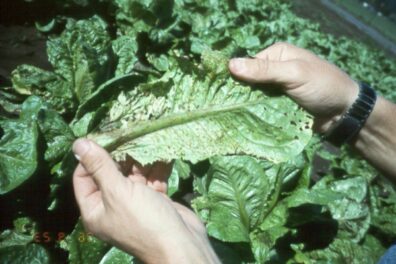
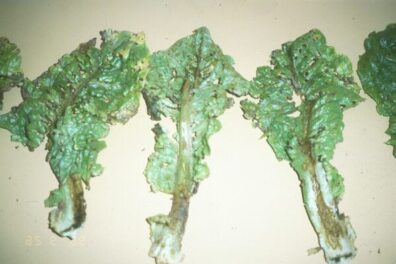
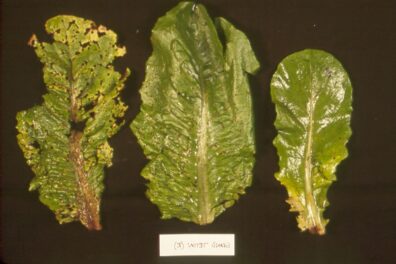
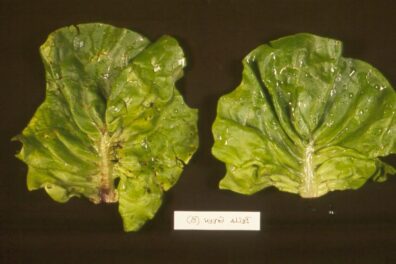
Anthracnose
Disease: Anthracnose
Pathogen: Microdochium panattonianum
On-Line Resources:
- Pacific Northwest Plant Disease Management Handbook: Lettuce (Lactuca sativa) – Anthracnose.
- Lettuce: Anthracnose, Washington State University Hortsense.
Downy mildew
Disease: Downy mildew
Pathogen: Bremia lactucae
Host crops: Lettuce and spinach
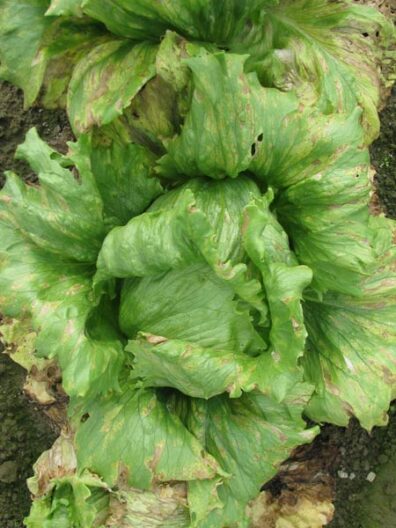
Photo Source: Lindsey du Toit
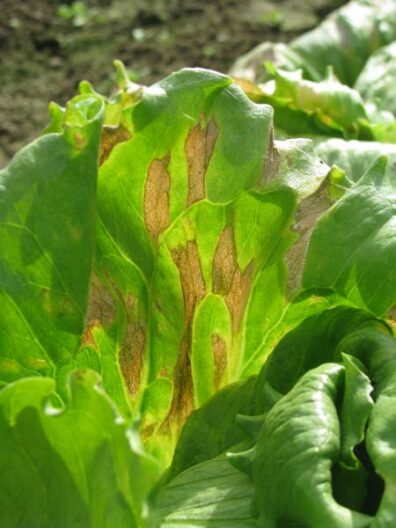
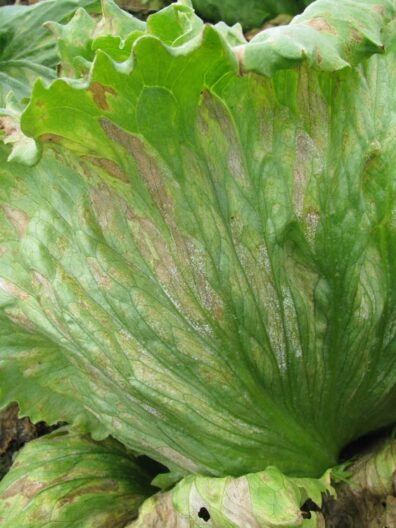
Photo Source: Lindsey du Toit
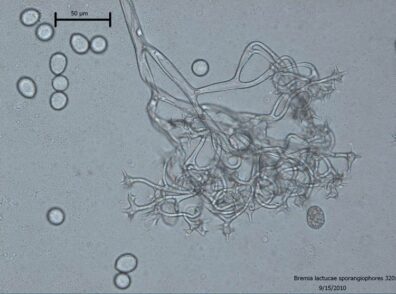
Photo Source: Lindsey du Toit
Online Resources:
- Pacific Northwest Plant Disease Management Handbook: Lettuce (Lactuca sativa) – Downy Mildew.
- See Lettuce: Downy Mildew. UC Pest Management Guidelines. UC IPM Online, University of California.
- See Models: Diseases: Lettuce: Downy Mildew. UC IPM Online, University of California.
White mold, lettuce drop, or Sclerotinia rot
Disease: White Mold, lettuce drop, or Sclerotinia rot
Pathogens: Sclerotinia sclerotiorum
Host crops: Bean, various brassica vegetables, carrot, eggplant, lettuce, potato, tomato, etc.
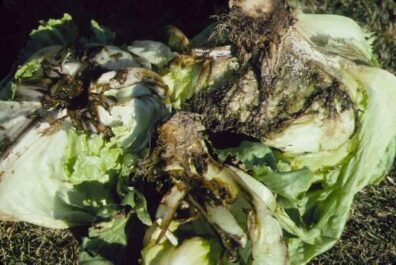
Photo Source: Lindsey du Toit
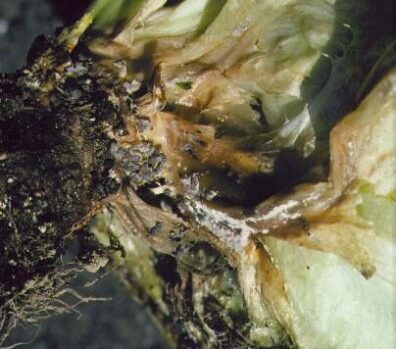
Photo Source: Lindsey du Toit
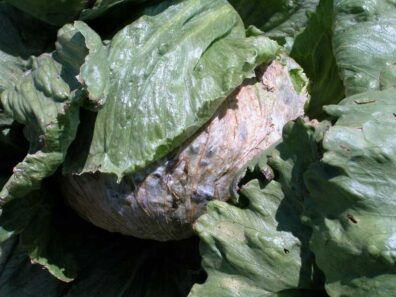
Photo Source: Bo-Ming Wu
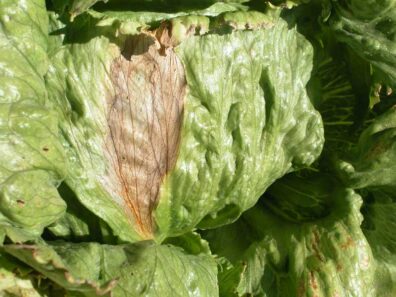
Photo Source: Bo-Ming Wu
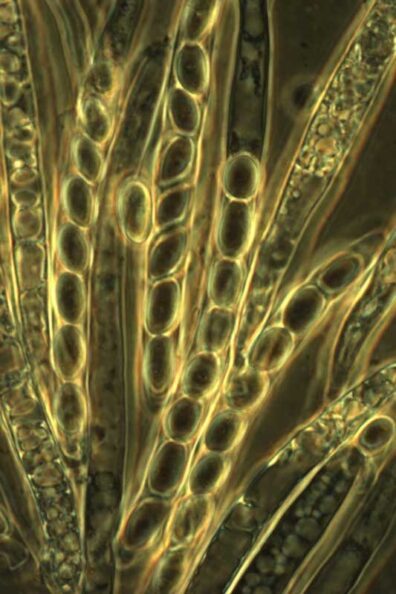
Photo Source: Bo-Ming Wu

Photo Source: Bo-Ming Wu
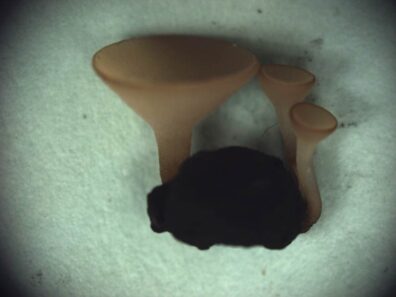
Photo Source: Bo-Ming Wu
On-Line Resources:
- Pacific Northwest Plant Disease Management Handbook: Lettuce (Lactuca sativa) – Drop {Sclerotinia Rot}.
- UC Pest Management Guidelines: Lettuce: Lettuce Drop. UC IPM Online. University of California.
- Diseases of lettuce ( Lactuca sativa ) in Arizona: Leaf drop. Extension Plant Pathology, The University of Arizona.
- Evaluation of Products to Manage Sclerotinia Leaf Drop of Lettuce in 2003. The University of Arizona Cooperative Extension.
- Important New York Vegetable Diseases: LETTUCE: Drop (Sclerotinia sclerotiorum). Vegetable MD Online, Cornell University.
- See Diseases, pests, and other problems common to many vegetables: White mold.
Insect/Mite Pests
Wireworm
Common name (of damaging stage): Wireworm (adults are called click beetles or snapping beetles)
Latin binomial: Ctenicera spp. and Limonius spp. Several kinds of wireworms are in the Pacific Northwest. Wireworms causing the most damage in irrigated areas are the Pacific Coast wireworm (Limonius canus), the sugar beet wireworm (L. californicus), the western field wireworm (L. infuscatus), and the Columbia Basin wireworm (L. subauratus). The Pacific Coast and sugar beet wireworms are the most common. Where annual rainfall is <15 inches, the Great Basin wireworm (Ctenicera pruinina) may be a problem, especially when irrigated crops are grown on sagebrush or dry wheat land. This species usually disappears after a few years of irrigation, but may be replaced by Limonius spp. which are favored by moist conditions. West of the Cascades, other wireworm species are pests, including Agriotes spp.
Host crops: All crops are susceptible to wireworm, but this pest is most destructive on beans, carrot, corn, grain, onion, potatoes, spinach seed crops, and other annual crops in the PNW.
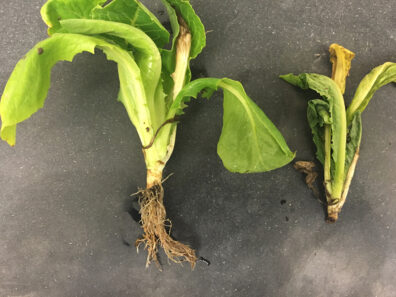
Photo Source: Photo courtesy of Rachel Bomberger, Washington State University
Online Resources:
- Pacific NorthwestInsect Management Handbook: Vegetable crop pests – Wireworm.
- Managing Wireworms in Vegetable Crops. Ontario Ministry of Agriculture and Food
- Wireworms. VegEdge, University of Minnesota.
- Wireworm Field Guide (pdf) – A guide to the identification and control of wireworms, Syngenta Crop Protection Canada, Inc.
- Wireworm Biology and Nonchemical Management in Potatoes in the Pacific Northwest, N. Andrews, M. Ambrosino, G. Fisher, and S.I. Rondon, Pacific Northwest Extension Publication no. PNW607
- See Diseases, pests, and other problems common to many vegetables: Wireworm.
If you need the content provided on this site in an alternate format or for further information on the Vegetable Seed Pathology program,
please contact: Lindsey du Toit at dutoit@wsu.edu or at 360-848-6140.
Our pages provide links to external sites for the convenience of users. WSU Extension does not manage these external sites, nor does Extension review, control, or take responsibility for the content of these sites. These external sites do not implicitly or explicitly represent official positions and policies of WSU Extension.