WSU Vegetable Pathology Team Newsletter
Hello!
Welcome to the May 2002 edition of Washington State University’s Vegetable Pathology Extension Team newsletter, the first edition of the 2002 growing season. This newsletter follows the team’s May conference call when team members discussed current vegetable diseases occurring in the state, their diagnoses and control. If you have questions or comments regarding vegetable diseases or WSU’s vegetable pathology team, contact Debbie Inglis (dainglis@wsu.edu) or Lindsey du Toit (dutoit@wsu.edu).
Places to Find Information
What is Plant Health Progress?
Plant Health Progress is a new multi-disciplinary science-based journal covering all aspects of applied plant health management. Both peer-reviewed and fully citable, the journal is an online-only publication. Plant Health Progress is a not-for-profit collaborative endeavor of the plant health community at large, serving practitioners worldwide. Its primary goal is to provide a comprehensive one-stop Internet resource for plant health information. Plant Health Progress publishes articles on all aspects of plant health including abiotic disorders, diseases, insects, nematodes, weeds, integrated pest management and / or regulatory issues.
New Disease Compendium Available
APS Press has now published the “Compendium of Diseases of Umbelliferous Crops” edited by R. M. Davis and R. N. Raid. The manual includes information about diseases of carrot, celery, cilantro, coriander, parsnip and other umbelliferous plants. To order call 1-800-328-7560. The cost is $49.
Learn to Manage Bedding Plants in Greenhouses/p>
Information about the new bulletin, “Pest Management for Herb Bedding Plants Grown in the Greenhouse”, published by the Universities of Connecticut and Massachusetts is available.
Need to Know More About Taking Digital Images?
Sending digital images sent to plant clinics can assist with the diagnosis of a plant disease (see our Aug 2001 newsletter). For further info on taking digital images.
View New Edition of Sustainable Ag News
A new edition of the PNW Sustainable Agriculture Newsletter, it includes articles about mustard green manures and the new organic standards.
Proceedings Available
The Continuing Studies program at Simon Fraser University has announced that the proceedings from their workshop, “Food of the Future—Comparing Conventional, Organic and Genetically Modified Food Crops: Understanding and Managing the Risks” is now available at their web site.
Food Safety Farm to Table Conference
The Food Safety Farm to Table Conference will be held May 29–30 at the University Inn at Moscow, ID. The sessions will cover foodborne pathogens of special importance for high-risk groups, food biosecurity, food safety activities at WSU and UI, and food safety of ready-to-eat foods. For more information.
Vegetable Diseases/Issues
Treating Seed for Disease Control
Spring, of course, is the time for planting. Many diseases of vegetables, caused by fungi bacteria or viruses, are carried in or on the seed. Disinfecting or treating seed to kill or suppress these organisms is important in controlling many vegetable diseases. One of the most common seed disinfecting methods is to soak seed in hot water (typically at temperatures around 120°F) for up to 20 minutes. However, this method needs to be tested in advance to make sure that it does not affect seed germination as vegetables, and even cultivars of the same species, differ in their sensitivity to injury by hot water treatments. Chemicals applied on the seed surface can also help protect seed and the developing seedling from decay or damping-off problems. In most cases, these materials are fungicidal in nature and help control diseases caused by plant pathogenic fungi. New biological seed treatments are also coming on the market for this purpose (see below). The PNW Plant Disease Management Handbook published by OSU, WSU and UI, gives the following instructions for treating seed:
- To treat small quantities of seed, use fungicides that are formulated as dusts. Shake seed and fungicide together, 3 to 5 minutes in a jar or can (not more than half full) with a tight-fitting lid. For small packets, add a pinch of dust to seed in the packet and shake well. For larger quantities of seed, use a rotary or mechanical mixer. Fungicide slurries often are more convenient for treating large amounts of seed.
- If the seeds you buy were treated by the seed dealer, do not treat them again.
- Most fungicides are either poisonous or noxious and must be handled with care. Follow manufacturer’s label directions for handling. Avoid breathing excessive amounts of fumes. Use a mask if treating large quantities of seed. Do not feed treated seed to livestock. Do not permit children to have access to the fungicide or to treated seed
Seed treatments alone cannot be solely relied upon to control the diseases against which they are directed. Often a seed treatment is only one step in a series of disease control practices. Growers are usually encouraged to purchase and plant seed that has been tested to be pathogen-free. Cultural practices such as field sanitation, rotation, destroying weed carriers, and foliar sprays may also help to insure season-long disease control, especially since disease causing organisms can be found in places other than in or on seed i.e., old crop refuse in the seedbed, greenhouse or field, in soil, and on weeds.
An example of the role of seed treatments in management of vegetable diseases is well illustrated with the following two diseases of watermelon: 1) watermelon fruit blotch caused by the seed-borne bacterium Acidovorax avenae subsp. citrulli, and 2) damping-off of watermelon caused by several fungi including Pythium spp., Rhizoctonia solani, and Fusarium spp.
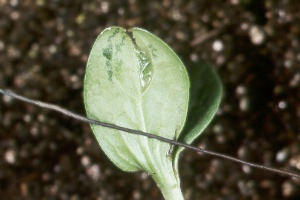
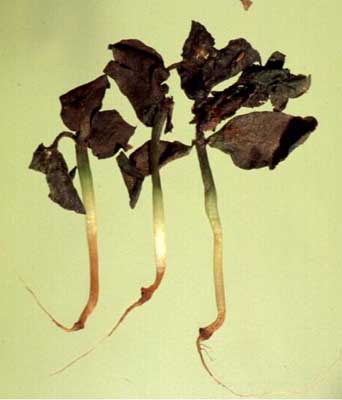
Symptoms of watermelon fruit blotch begin on seedlings as small, water-soaked lesions on the underside of the cotyledons; lesions later become necrotic. In a greenhouse setting, a single infected plant in a tray can infect nearby plants, leading to epidemics after the seedlings are transplanted in a field. This disease is managed through planting seeds that have tested free of bacteria, managing watering practices/systems to minimize splash dispersal of the pathogen, spacing plants adequately for improved air circulation (particularly in greenhouse production of transplants), and foliar copper applications in the field.
Some common seedborne diseases on some vegetables in Washington
Fusarium oxysporum f. sp. asparagi Fusarium proliferatum Fusarium redolens
- Disease: Fusarium root and crown rot
- Notes: Treatment of both seed and crowns are recommended.
Bean common mosaic virus (transmitted by seed and by aphids)
- Pythium; Rhizoctonia solani
- Disease: Bean common mosaic
- Notes: Many seed treatments are available.
Pythium; Rhizoctonia solani
- Disease: Damping-off and stem rot
- Notes: Many seed treatments are available.
Pseudomonas syringae pv. phaseolicola and pv. syringae,
- Disease: Halo blight and brown spot
- Notes: Plant bacteria-free seed. Some seed treatments available.
Alternaria dauci Alternaria radicina
- Disease: Alternaria leaf spot and leaf blight Black rot
- Notes: Use pathogen-free seed and transplants.
Pythium spp. and Rhizoctonia spp.
- Disease: Damping-off
- Notes: Seed treatments are available.
Pythium ultimum, Fusarium moniliforme, Fusarium spp., and Penicillium oxalicum (sweet corn)
- Disease: Halo blight and brown spot
- Notes: Plant bacteria-free seed.
Sphacelotheca reiliana
- Disease: Head smut
- Notes: Seed treatments are available.
Pythium ultimum Rhizoctonia solani
- Disease: Damping-off
- Notes: Seed treatments are available.
Lettuce mosaic virus (transmitted by seed and the green peach aphid)
- Disease: Lettuce mosaic
- Notes: Using virus-free seed is the best means of control
Phoma medicaginis var. pinodella Ascochyta pisi Mycosphaerella pinodes
- Disease: Ascochyta blight (basal stem rot or black stem)
- Notes: Use seed produced in disease-free fields.
Aspergillus niger
- Disease: Black mold
- Notes: For seed treatments. Hot water seed treatments can be effective
Botrytis allii
- Disease: Neck rot and bulb rot
- Notes: For seed onions, use a seed treatment.
Urocystis magica and Urocystis colchici
- Disease: Smut
- Notes: Use a seed treatment.
Pseudomonas syringae pv. pisi
- Disease: Bacterial blight
- Notes: For small seed lots, blight infested seed can be treated with house-hold bleach (10%) for 1 to 5 min; use disease-free seed.
Peronospora viciae
- Disease: Downy mildew
Pea seedborne mosaic virus
- Disease: Pea seedborne mosaic
- Notes: Monitor principal
Pythium spp., Rhizoctonia solani, Thielaviopsis basicola, Phoma medicaginis var. pinodella
- Disease: Seed rot and damping-off
New Biological Seed Treatments for Vegetable Crops
Washington State Department of Agriculture has registered two new biological fungicide seed treatment products for use, Kodiak Flowable Biological Fungicide and Kodiak Vegetable FL Biological Fungicide. The crop uses include bean (dry), bean (green), bean (kidney), bean (lima), bean (navy), bean (pinto), and pea (green). On vegetables, Kodiak provides protection against Fusarium, Rhizoctonia, and other diseases. For further information, visit the Gustafson Inc.
If you need the content provided on this site in an alternate format or for further information on the Vegetable Seed Pathology program,
please contact: Lindsey du Toit at dutoit@wsu.edu or at 360-848-6140.
Our pages provide links to external sites for the convenience of users. WSU Extension does not manage these external sites, nor does Extension review, control, or take responsibility for the content of these sites. These external sites do not implicitly or explicitly represent official positions and policies of WSU Extension.