WSU Vegetable Pathology Team Newsletter
Hello!
Welcome to the July 2001 edition of Washington State University’s Vegetable Pathology Extension Team. This newsletter follows the team’s July conference call when team members discussed current vegetable diseases, diagnoses and control. Please use this information in your own newsletters and activities.
Photos needed for our website’s new Vegetable Disease Gallery
We now have many excellent photographs of vegetable disease symptoms for our new vegetable pathology team web site photo gallery, but we eventually wish to post additional slides at:
Photo Gallery of Vegetable Problems
We believe this vegetable disease “photo gallery” will be one way you can quickly access and reference images of vegetable disease symptoms. To contribute, contact dainglis@wsu.edu
Need to know about cultural management options & Washington-registered pesticides for home gardens?
Check out the vegetable section of WSU’s Hortsense website. Information about cultural management options and current pesticide recommendations available to home gardeners for Washington-registered pesticides on asparagus, beans, chard, broccoli, crucifers, cantaloupe, melon, carrot, corn, pumpkin, squash, lettuce, onion, garlic, pea, pepper, eggplant, potato, radish, spinach, tomato, turnip and rutabaga.
Vegetable Diseases/Issues and Places to Find Information
“A Whiter Shade of Pale” – Is this rust or white rust?
In the June newsletter, we focused on differences between downy and powdery mildew. These two diseases are sometimes confused with one another, but actually are distinct. Two other foliar diseases on vegetable crops that may be confused with one another are rust and white rust. Like the downy and powdery mildews, both rusts are obligate parasites and require an association with host tissue for long term survival. However, just as the downy and powdery mildew organisms belong to different groups of pathogenic fungi, rust is a basidiomycete while white rust is an oomycete. This means that different types of fungicides are required for their control. The following comparisons might be useful for distinguishing between the two types of rust. Both types of rusts form pustules which can rupture host epidermal cells and reveal powdery spore masses (hence the name “rust”). Rust may produce up to five distinct fruiting structures and spore forms which appear in sequence (teliospores, basidiospores, pycniospores, aeciospores and urediospores) although many rusts produce only one or a few of these spore types. In contrast, white rust produces sporangiospores, zoospores and oospores. Note that no crop is affected by both, and that white rust affects cruciferous plants primarily.
Common vegetable hosts in Washington and the rust species affecting them
- Asparagus(Puccinia asparagi)
- Bean (Uromyces appendiculatus)
- Beet (Uromyces betae)
- Corn (Puccinia sorghi = common rust
- Corn (Puccinia polysora =southern rust)
- Garlic, Leeks, Onion (Puccinia spp.)
Conditions favoring infections
Generally, rust is favored by moderate temperature and high humidity and moistureFor beet rust, if the tops of beet are destroyed by the disease, it may be difficult to pull the beets from the groundFor common rust on corn, wood sorrel (Oxalis spp.) is an alternate host; common rust is only seen occasionally in the PNWFor onion rust, seed yield may be reduced if seed stalks become girdled
Cultural management strategies
- Plant resistant cultivars
- Eliminate volunteer plants & alternate hosts
- Rotate with nonhost crops
- Encourage decomposition of debris
Generalized disease cycle
Overwinters on old stems; the summer spore stage (uredial stage–probably the most damaging stage), is windborne and may go through several cycles in one growing season.
On beet: similar to other rusts but may also be seedborne.
Typical signs and symptoms
On asparagus: the winter stage consists of oval yellowish spots on stems; these spots contain the fruiting bodies (aecia and pycnia) of the fungus; the summer spore stage consists of pustules (uredia) which are brown and powdery; the autumn stage is made up of black spore masses (telia)
On bean: In spring white blisters (pycnia) develop on the upper surface of leaves; in a few weeks the lower surfaces of the blisters (aecia) turn white and produce white powdery spores (aeciospores); in summer brown spots (uredia) produce brown powdery spores (urediospores); black spots and spores (telia and teliospores) may be evident in the fall
On beet: Small reddish brown spots (uredia) form on leaf surfaces; a dark brown stage (telial) may be evident at the end of the growing season
On onion: Light yellow to red pustules (uredia) affect leaves and stalks
Note: On corn: There are two different rusts on corn. P. sorghi causes common rust which sometimes occurs in the PNW, and P. polysora causes southern rust which occurs primarily in the southeastern US. Common rust pustules (uredia) can be found on upper & lower leaf surfaces whereas southern rust pustules, which are lighter brown, usually are more numerous on upper leaf surfaces, ears, stalks and/or leaf sheaths.
Common vegetable hosts in Washington and the rust species affecting them
- Horseradish
- Radish
- Rapeseed
- Wild mustards
Conditions favoring infections
Leaf infection occurs readily at 68°F when free water is present. Long periods of free water inhibit spore germination because spores must dry before germination occurs. The disease is known throughout the world where crucifers are grown, and many cruciferous weeds are hosts.
Cultural management strategies
Locate fields away from established susceptible crops; control wild mustards; plant resistant cultivars; incorporate debris into soil after harvest
Typical signs and symptoms
Overwinters as oospores in plant debris or mycelium in perennial plants. Secondary infections occur by windborne sporangiospores which invade the stomata by germ tubes.
| Rust | White Rust (Albugo candida) | |
| Conditions favoring infections | ||
| Cultural management strategies | ||
| Generalized disease cycle | ||
| Typical signs and symptoms | ||
| . | Note: On corn: There are two different rusts on corn. P. sorghi causes common rust which sometimes occurs in the PNW, and P. polysora causes southern rust which occurs primarily in the southeastern US. Common rust pustules (uredia) can be found on upper & lower leaf surfaces whereas southern rust pustules, which are lighter brown, usually are more numerous on upper leaf surfaces, ears, stalks and/or leaf sheaths. | 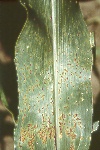 Common rust on corn |
Visit The Skagit Veg Trials
The Skagit Veg Trials, an annual vegetable trial and display garden, was added to the Skagit Display Gardens at the WSU-Mount Vernon Research and Extension Unit this spring. The aim of the project, led by Dr. Wilbur ‘Andy’ Anderson and sponsored by the Skagit Men’s Garden Club, is to identify the best available vegetable varieties and cultural practices for the Puget Sound maritime climate. Identifying varieties that emerge in cool soils and have a range of maturities – early, mid and late – allows the commercial or home gardener to plant at one time but harvest over a long period.
The project will work its way through the major vegetables over a 6 or 7 year period. This year’s trials include 45 varieties of peas and 185 varieties of corn. Three types of peas are being tested – shell, snap and snow peas. Corn trials include yellow, white and bi-color varieties in each of three sweetness levels – normal sugar, sugar-enhanced and supersweet. About 26 varieties of spinach and 30 varieties of tomatoes are also being tested. All trials are replicated in either time or in plots. The peas are replicated this year in plots. The corn will be replicated in time, that is, the varieties that do the best this year will be tested again next year. Cultural studies this year include metam-sodium fumigation for weed and disease control, and spray blade fumigation to control weeds and diseases in the planted rows.
For directions to the Trials and a list of trial activities, contact Nancy Ligget at liggett@coopext.cahe.wsu.edu
The Puget Sound Fresh website presents descriptions of western Washington farms and the crops they produce for consumers. Farms can advertise for free on this web site.
If you need the content provided on this site in an alternate format or for further information on the Vegetable Seed Pathology program,
please contact: Lindsey du Toit at dutoit@wsu.edu or at 360-848-6140.
Our pages provide links to external sites for the convenience of users. WSU Extension does not manage these external sites, nor does Extension review, control, or take responsibility for the content of these sites. These external sites do not implicitly or explicitly represent official positions and policies of WSU Extension.