WSU Vegetable Pathology Team Newsletter
In This Issue
- Hello
- Pest Alert (High Plains Virus on Sweet Corn)
- Upcoming Vegetable Events and Announcements
- Information About Diagnosing Leafy Vegetable Diseases
Hello!
Welcome to the August 2003 edition of Washington State University’s Vegetable Pathology Extension Team newsletter, the final edition of the 2003 growing season. If you have suggestions for next year’s growing season newsletters, please let us know.
If you havequestions or comments about vegetable diseases and pests, or WSU’s Vegetable Pathology Team, contact Debbie Inglis (dainglis@wsu.edu) or Lindsey du Toit (dutoit@wsu.edu).
Pest Alert!!!
Field Days
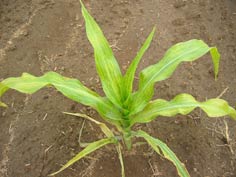
High Plains Disease Caused by the High Plains Virus
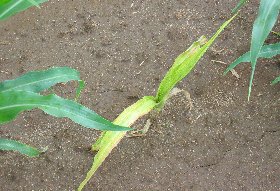
Photos courtesy of Gary Q. Pelter
There have been reports this season of severe outbreaks of high plains disease (HPD) in sweet corn fields in several counties in the Columbia Basin. HPD is caused by the High plains tenuivirus (HPV). The disease was first detected in Colorado, Kansas, and Texas in 1993; in Utah in 1994; and in Washington in 1998.
Hosts: HPV can infect field corn and sweet corn, wheat, barley, yellow and green foxtail, and witchgrass.
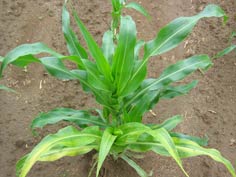
Symptoms: Mosaic symptoms are usually first evident on leaves emerging from the whorl, although older leaves may also develop mosaic symptoms (Fig. 1 and 2). Infected plants may be stunted and yellowish (Fig. 3). Yellow or red-purple (depending on the genetic background of the corn cultivar) bands ¼ to ½” in width and running parallel to the veins may be observed on intermediate to fully-developed leaves. These bands later turn necrotic. Infected plants may have stunted or weakened root systems.
Transmission: HPV is transmitted by: 1) the wheat curl mite (Aceria tosichella), a tiny eriophyid mite which also transmits wheat streak mosaic virus (WSMV); and 2) corn seed. Corn plants can be infected with both HPV and WSMV. The mite, which is barely visible with a 10x magnifying lens, can be blown between fields. As a result, a distinct disease gradient is sometimes evident on corn crops planted immediately adjacent to infected wheat crops. Seed transmission is thought to be very low, although the pattern of symptom development in some outbreaks of HPD in sweet corn crops have suggested higher incidences of seed transmission.
Management: Management options for HPD are limited. Avoid seeding crops late. Control grassy weeds and volunteer wheat, which may serve as reservoirs of HPV and on which the wheat curl mite may persist. If possible, avoid planting sweet corn crops immediately adjacent to wheat crops. The objective is to break the ‘green bridge’ effect and prevent spread of the HPV in the mite vector. As resistance screening efforts progress, plant resistant corn cultivars. Limited information is currently available on the resistance of sweet corn hybrids to HPD, but known susceptible hybrids include: Ambrosia, Challenger, Crisp ‘n Sweet, DMC 20-3, DMC 20-10, Double Gem, Extra Sweet, Honey and Pearl, How Sweet It Is, Native Gem, Phenominal, Shasta, Style Sweet, and 710. Resistant or tolerant hybrids include: Delectable, Empire, Gemini, Imaculata, Incredible, Platinum Lady, Silver Queen, and 711.
Upcoming Vetgetable Events and Announcements
New Book on Genetically Modified Crops
The World Scientific Publishing of the Imperial College Press in London has published “Genetically Modified Crops” by Nigel G. Halford. The book describes the history and development of the science of biotechnology. It also features the GM crops that are grown commercially around the world, and the new varieties that are currently being developed. l
New Bulletin from Skagit Veg Trials Available
A new bulletin “Temperature Modification Techniques for the Growing Environment in the Puget Sound” prepared by the volunteers of the Skagit Veg Trials and Dr. Andy Anderson, Skagit Veg Trials Director, is now available. Information on transplanting, raised beds, solar mulch, cloches, plastic mulches and combined strategies for modifying soil temperature is included. For copies, contact andersonw@wsu.edu
New Organic Agriculture Resource Guide
OrganicAgInfo is an on-line database of research reports, farmer-to-farmer information, and outreach publications on organic agriculture. The database is being hosted by North Carolina State University, and was funded by grants to the Scientific Congress on Organic Agricultural Research and the Organic Agriculture Consortium from the Initiative for Future Agriculture and Food Systems through USDA-CSREES.
Onion Field Day
The 2003 Columbia Basin Onion Field Day will be held Thursday, August 28 from 9:00 am until noon at Grigg and Sons Farm near Quincy, WA. Forty-six onion cultivars and lines from nine seed companies will be compared and contrasted, and gray mold research explained. For more information, contact Gary Pelter at 509-754-2011.
Plant Disease Diagnosis
For a comprehensive guide to plant disease diangosis see the APSnet Education Center Introductory Topic article written by M. B. Riley, M. R. Williamson and O. C. Maloy.
Searching for Plant Science Images?
The site contains more than 1,500 high quality photographs, graphics, charts, graphs, maps, biological drawings, chemical structures, diagrams and disease cycles focused on plant science. Subscriptions are $38.
WSU Cooperative Extension Has On-line Publications
You can download hundreds of WSU publications free of charge at the new WSU publications catalog and sales site at the Extension Publication store. Should you choose others, ordering is very easy. Temporary discounts of up to 25% on some publications are being offered.
Information About Diagnosing Leafy Vegetable Diseases
Foliar diseases on leafy vegetables in northwestern Washington
The following is an excerpt from the WSU-Vegetable Pathology Team’s Leafy Vegetable Workshop, presented by Lindsey du Toit, Jenny Glass and Debbie Inglis on July 24, 2003 at WSU-Mount Vernon.
Foliar diseases on leafy vegetable crops in Washington can be caused by both obligate and non-obligate parasites. Obligate parasites are organisms that can grow and multiply only in or on living tissue, and include Peronospora, an oomycete causing downy mildew; Erysiphe, one of the fungi causing powdery mildew; Albugo, an oomycete causing white rust; and, Uromyces and Puccinia two fungi which cause common rust. Erisphe belongs to the ascomycetes, and Uromyces and Puccinia are basidiomycetes. Some examples of non-obligate parasites include spinach leaf spot fungi (Cladosporium, Stemphylium, and Colletotrichum); the beet and chard leaf spot fungi (Phoma, Ramularia, and Cercospora), and crucifer foliar pathogens (Alternaria and Mycosphaerella). These fungi are ascomycetes or deuteromycetes.
Correct diagnoses of leafy vegetable foliar diseases are important because they can lead to appropriate fungicide selection, improve the timing of fungicide applications, assist with the selection of cultivars with higher levels of resistance, and determine appropriate cultural practices for more effective disease management.
The downy mildews are some of the most commonly encountered foliar diseases on leafy vegetables in the PNW. They are also relatively easy to diagnose (see photos in table below). Favorable conditions for downy mildew outbreaks include cool temperatures ranging from 50 to 60 °F and high moisture related to low cloud ceilings, dew, fog and rain.
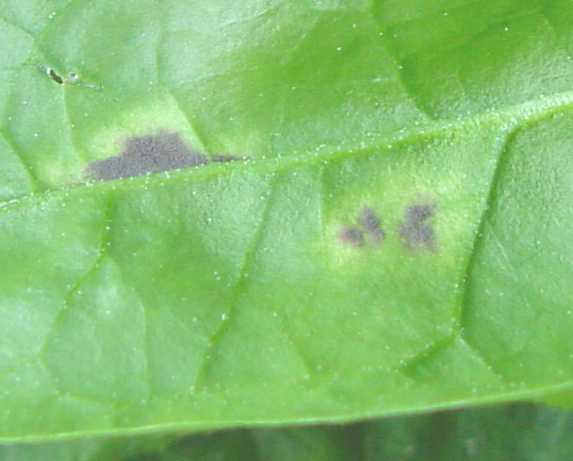
Peronospora farinosa f. sp. spinaciae on spinach
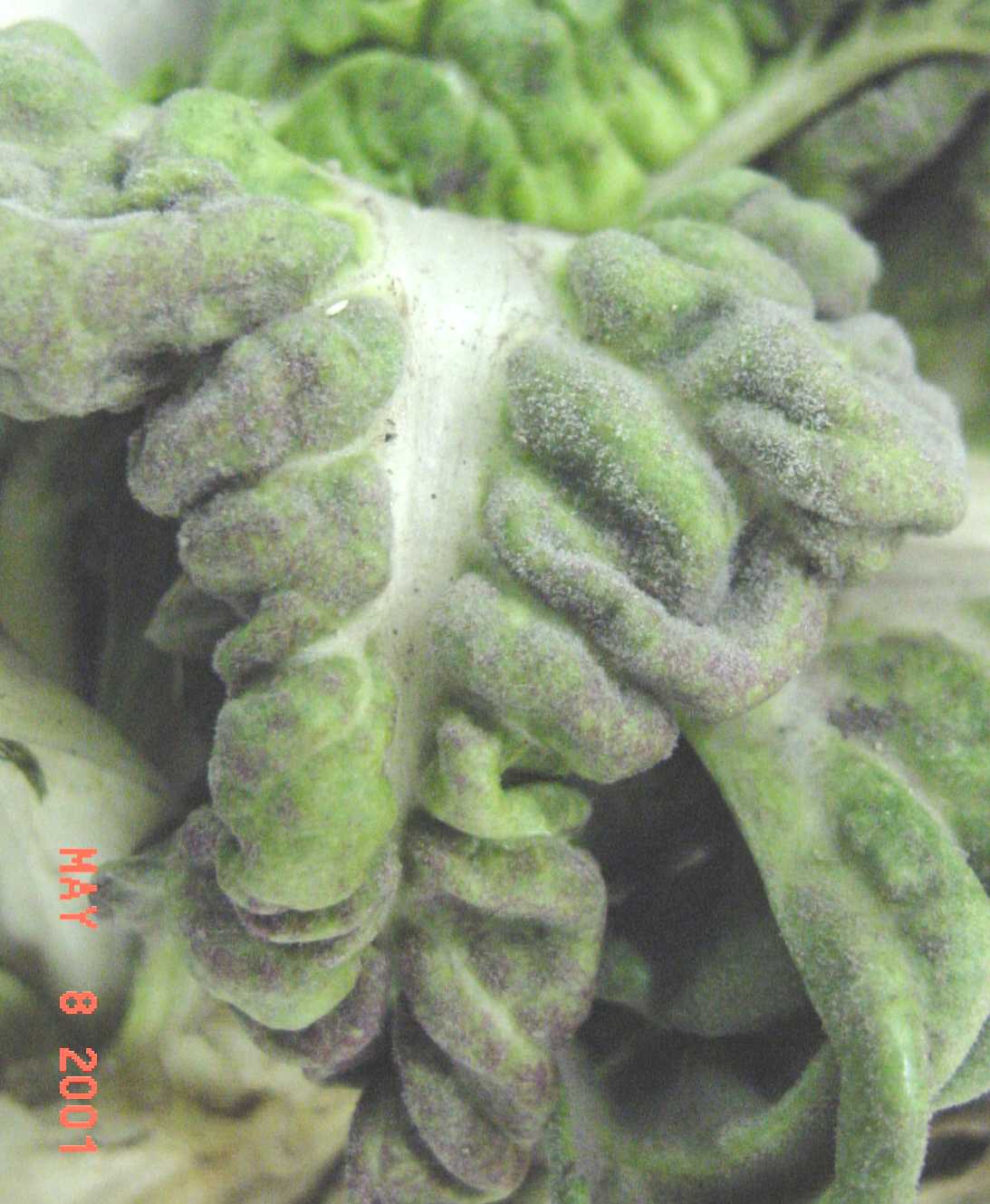
Peronospora farinosa f. sp. betae on Swiss chard
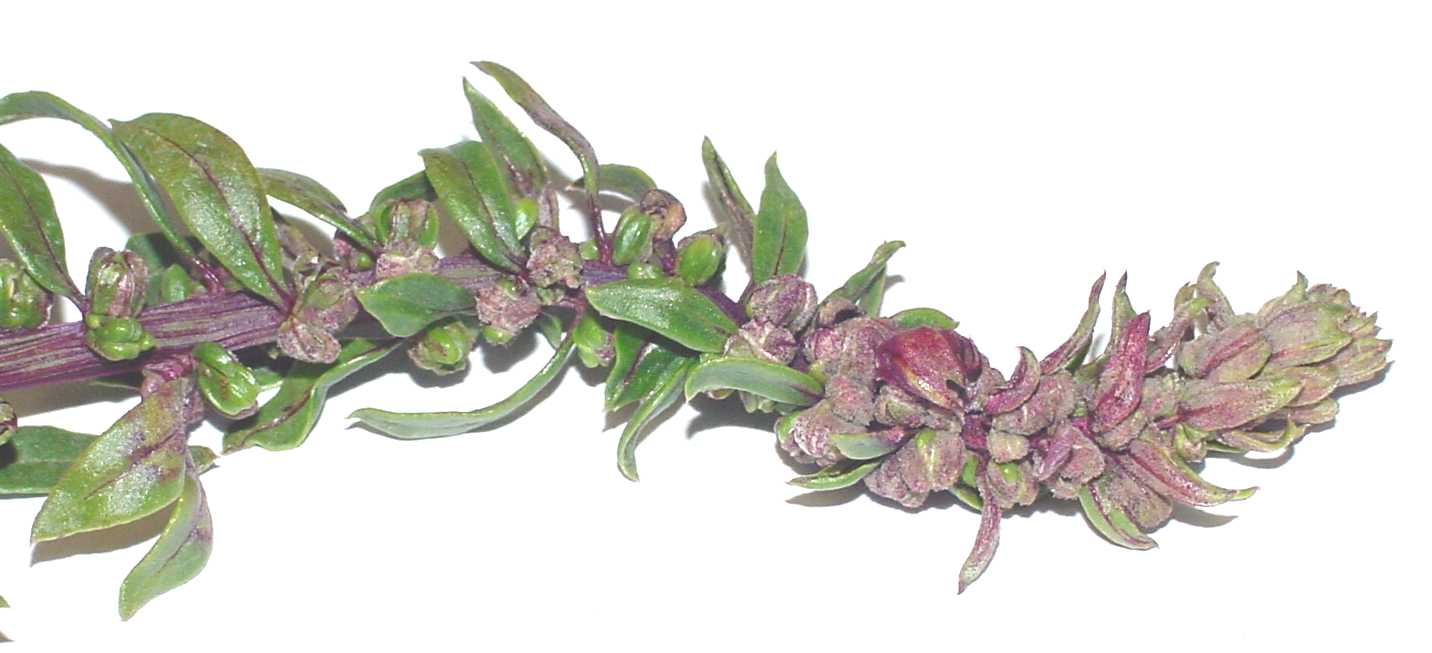
Note grayish green felt-like growth and twisted leaf
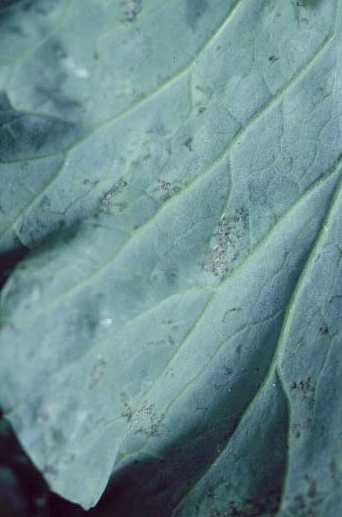
Peronospora parasitica on cabbage
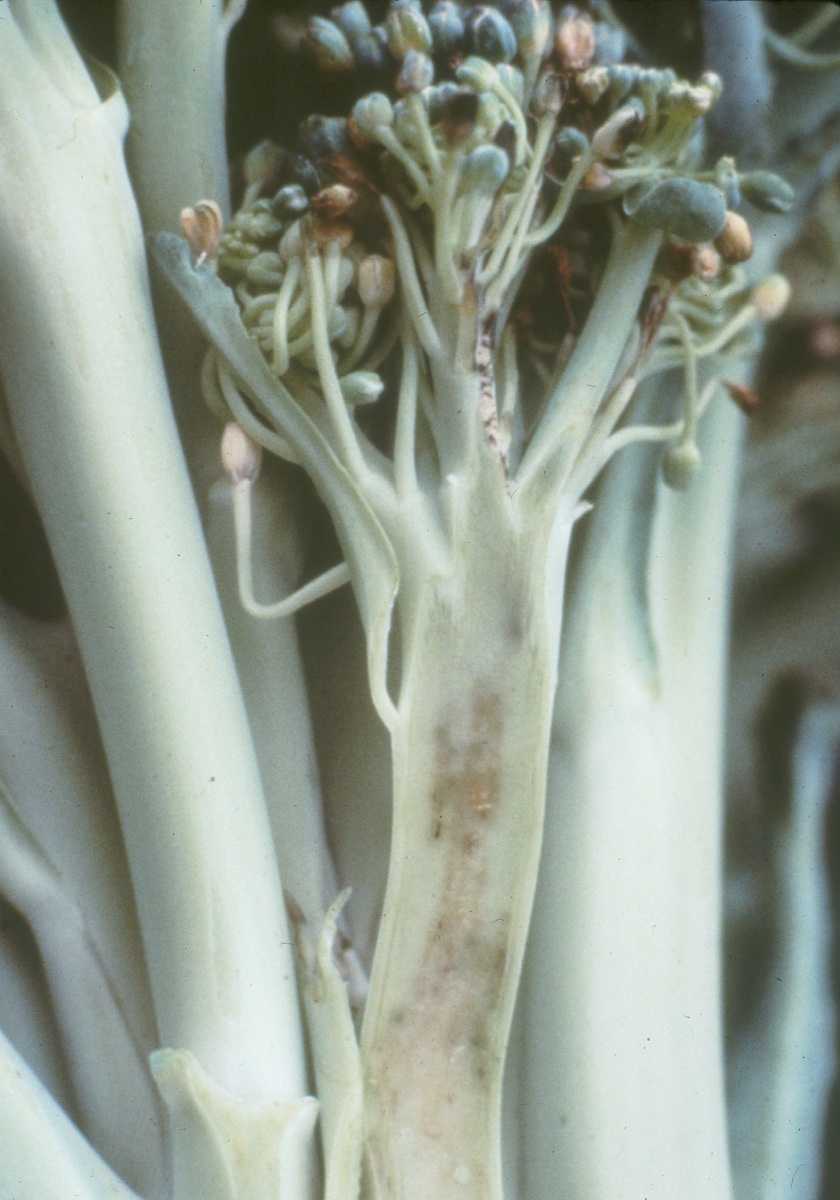
Peronospora parasitica on broccoli
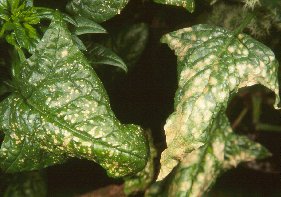
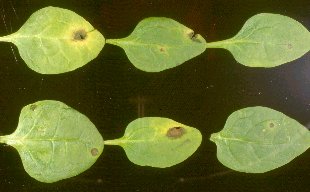
Leaf spot diseases on leafy vegetables are quite common in the PNW, although they can be somewhat more challenging to diagnose than downy mildews. Often the pathogens need to be cultured from the diseased leaf tissues, and the spores from the fungal colonies identified with the use of a microscope before the diagnosis can be made.
Cladosporium leaf spot
Cladosporium leaf spot
- Leaf spot symptoms: Distinct, 1-3 mm spots, develop dark margin
- Dispersal: Wind, seed
- Overwintering: Volunteers, seed
- Favorable conditions: Moist, cool
- Host range: Chenopod species, others?
Stemphylium leaf spot
Stemphylium botryosum
- Leaf spot symptoms: Diffuse, rapidly expanding
- Dispersal: Wind, seed
- Overwintering: Woody spinach debris, seed
- Favorable conditions: Moist, warm, pollen on leaves
- Host range: Spinach
Anthracnose
Colletotrichum dematium
- Leaf spot symptoms: Distinct, coalescing, water-soaked in humid conditions
- Dispersal: Splashing water, seed
- Overwintering: Splashing water, seed
- Favorable conditions: Volunteers, seed
- Host range: Spinach
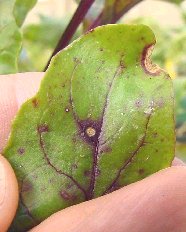
Alternaria leaf & pod spot
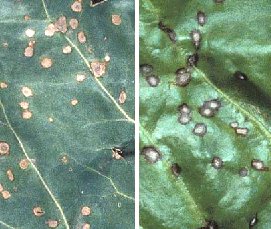
Alternaria brassicicola &
A. brassicae
- Symptoms: Black circular to irregular lesions, necrotic center; Circular to elongated black spots on pods and racemes
- Spores in leaf spots: Naked spores
- Dispersal: Wind, insects, windblown rain
- Overwintering: Debris, biennial seed crops, seed
- Favorable conditions: Moist, warm
- Host range: Crucifers
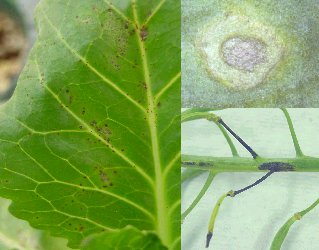
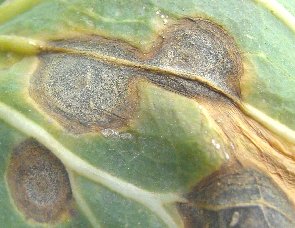
Ring spot
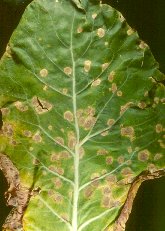
Mycosphaerella brassicicola
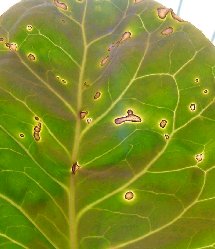
- Symptoms: Circular lesions (up to 2 cm diameter), definite margin & chlorotic halo, concentric zonation, on older leaves
- Spores in leaf spots: Black fruiting bodies (pycnidia &/or perithecia) in concentric rings
- Dispersal: Splashing water, insects
- Overwintering: Debris, biennial seed crops
- Favorable conditions: Moist, cool
- Host range: Crucifers
Bacterial foliar diseases of crucifer crops
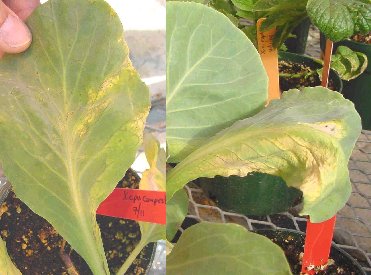
Black Rot
Xanthomonas campestris pv. campestris
- Symptoms: Yellow leaves, wilting, black veins, V-shaped lesions from leaf margin
- Dispersal: Splashing water, seed, insects
- Overwintering: Debris, cruciferous weeds, soil
- Favorable conditions: Warm to hot, moist
- Host range: Crucifers (including weeds)
Xanthomonas leaf spot
campestris pv. raphani or campestris pv. armoraciae
- Symptoms: Circular, water-soaked leaf spots, chlorotic halo; dark lesions on petioles
- Dispersal: Splashing water, seed, insects
- Overwintering: Debris, cruciferous weeds, soil
- Favorable conditions: Cool to warm, extended wet periods
- Host range
- pv. raphani: Cabbage, broccoli, cauliflower, kale, radish, tomato, pepper
- pv. armoraciae: Cabbage, broccoli, cauliflower, kale, radish, horseradish
Peppery leaf spot
Pseudomonas syringae pv. maculicola
- Symptoms: Circular to angular spots, chlorotic halo
- Dispersal: Splashing water, seed, insects
- Overwintering: Debris, cruciferous weeds, soil
- Favorable conditions: Cool, wet
- Host range: Cabbage, broccoli, cauliflower, Brussel sprouts, turnip
PDF Accessibility
If you need the content provided on this site in an alternate format or for further information on the Vegetable Seed Pathology program,
please contact: Lindsey du Toit at dutoit@wsu.edu or at 360-848-6140.
Our pages provide links to external sites for the convenience of users. WSU Extension does not manage these external sites, nor does Extension review, control, or take responsibility for the content of these sites. These external sites do not implicitly or explicitly represent official positions and policies of WSU Extension.